This article renders the completed, frozen stage1-heterogeneous-v2
synthetic-evidence artifact. It does not rerun the
benchmark, tune a candidate, or make a biological claim. The complete
artifact is hash-verified before its contents are read.
Result
The calibration rule selected C2_block_scaled_svd, but
the frozen holdout acceptance rule failed. Therefore no
heterogeneous Stage 1 baseline is accepted and Issue #24
remains blocked. C1 cannot be substituted after this result: it was not
the calibration-selected candidate, and the v2 holdout is consumed.
knitr::kable(data.frame(
  field = c("protocol", "protocol digest", "generator digest", "artifact verification",
            "completed tasks", "result rows", "source commit", "calibration selection",
            "holdout decision", "holdout thresholds passed"),
  value = c(
    evidence$manifest$protocol_id,
    evidence$selection$protocol_digest,
    evidence$selection$generator_digest,
    "complete payload and content-addressed name verified",
    completed_tasks,
    nrow(evidence$results),
    evidence$environment$commit,
    evidence$selection$selected_candidate,
    evidence$holdout$decision,
    evidence$holdout$thresholds_passed
  ),
  stringsAsFactors = FALSE
), col.names = c("Field", "Value"))| Field | Value |
|---|---|
| protocol | stage1-heterogeneous-v2 |
| protocol digest | dcae519df4a6975e9715bdaa69a5649fa00f1b35ffb0feb71e3fe59c34cb9226 |
| generator digest | 47030b60f48f7d859f92fc05ce33f95fe6e04fa164eddbecc8009c64eab097dc |
| artifact verification | complete payload and content-addressed name verified |
| completed tasks | 40960 |
| result rows | 81920 |
| source commit | 6f1f0614b2c4f0d539baa69a20df1ef43705ade6 |
| calibration selection | C2_block_scaled_svd |
| holdout decision | failed |
| holdout thresholds passed | FALSE |
Execution inventory
The verified table contains all 40,960 deterministic stratum-by-seed tasks and no failed contract-gate rows. Expected missing-ID controls remain successful when they emit their required typed failure.
knitr::kable(data.frame(
  field = c("completed deterministic tasks", "candidate-result rows", "failed contract-gate rows"),
  value = c(completed_tasks, nrow(evidence$results), sum(!evidence$results$gate_passed)),
  stringsAsFactors = FALSE
), col.names = c("Field", "Value"))| Field | Value |
|---|---|
| completed deterministic tasks | 40960 |
| candidate-result rows | 81920 |
| failed contract-gate rows | 0 |
Holdout threshold readout
The protocol requires every exact-ID stratum with shared signal 24 and noise SD 1 to meet both thresholds. This table reports the worst median among those frozen strata; a value above its threshold is sufficient to reject the candidate.
summary <- evidence$holdout$summary
required <- summary[
  summary$projection_case == "exact_ids" &
    summary$shared_signal == 24 &
    summary$noise_sd == 1 &
    summary$metric %in% c("shared_recovery_error", "projection_error"),
  , drop = FALSE
]
thresholds <- c(shared_recovery_error = 0.25, projection_error = 0.30)
threshold_readout <- do.call(rbind, lapply(names(thresholds), function(metric) {
  values <- required$estimate[required$metric == metric]
  data.frame(
    metric = metric,
    exact_id_strata = length(unique(required$stratum_digest[required$metric == metric])),
    worst_median = max(values),
    threshold = thresholds[[metric]],
    all_strata_pass = all(values <= thresholds[[metric]]),
    stringsAsFactors = FALSE
  )
}))
knitr::kable(transform(threshold_readout, worst_median = round(worst_median, 3)),
col.names = c("Metric", "Exact-ID strata", "Worst median", "Threshold", "All pass"))| Metric | Exact-ID strata | Worst median | Threshold | All pass |
|---|---|---|---|---|
| shared_recovery_error | 128 | 0.390 | 0.25 | FALSE |
| projection_error | 128 | 0.343 | 0.30 | FALSE |
Holdout figures
sre_dat <- exact[exact$metric == "shared_recovery_error", ]
.draw_holdout_panel(sre_dat,
  metric_label = "Holdout shared-subspace recovery error (C2)",
  threshold = 0.25,
  ylab_text = "Shared recovery error (lower is better)"
)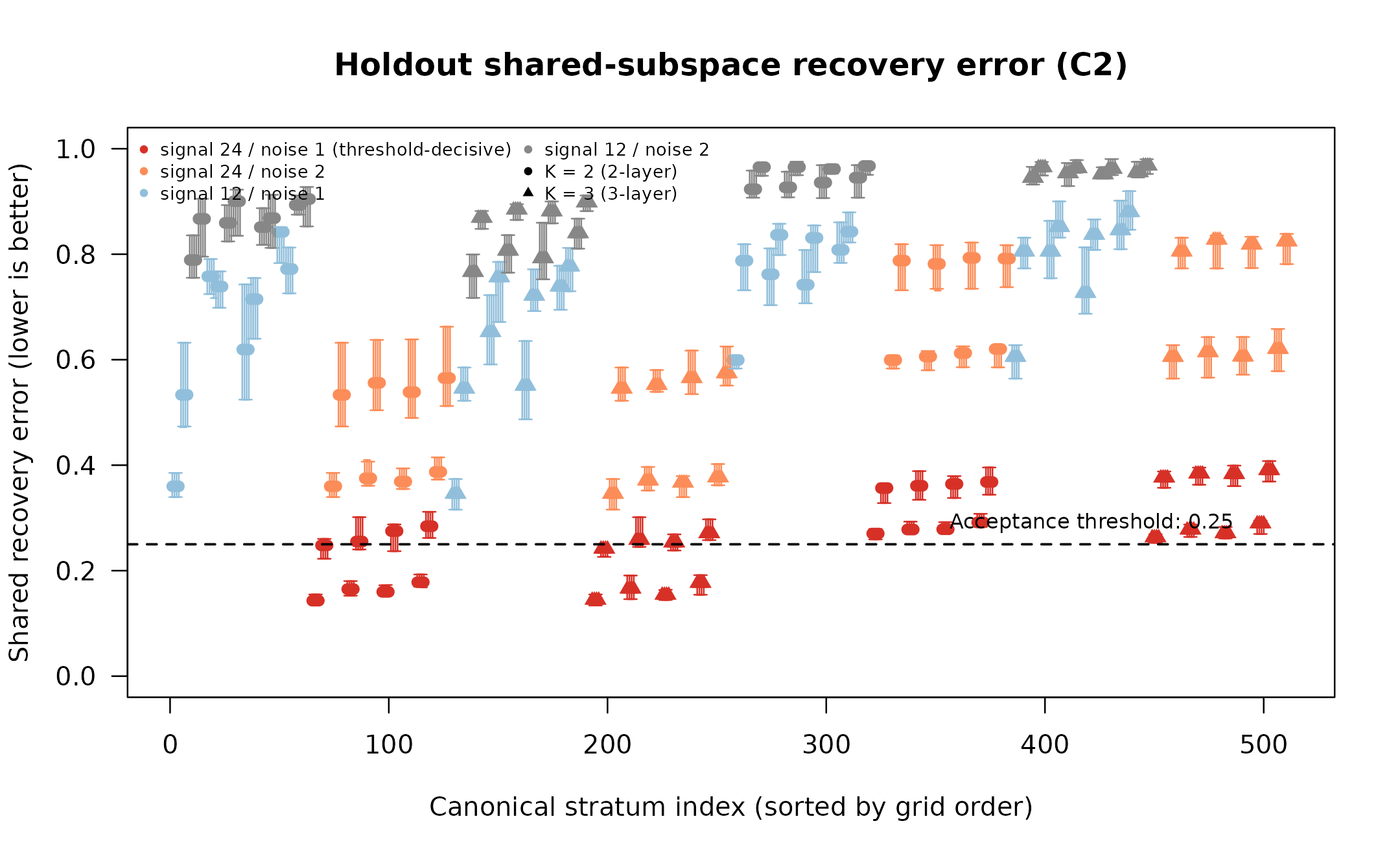
Figure 1. C2 holdout shared-subspace recovery error across all exact-ID strata. Each point is the median shared-recovery error (lower is better) for one canonical stratum over 20 holdout seeds, with 95% bootstrap confidence intervals. Colour encodes the signal-to-noise regime: red = high signal (24) / low noise (1), the threshold-decisive conditions; orange = high signal / high noise; blue = low signal (12) / low noise; grey = low signal / high noise. Triangle symbols indicate 3-layer (K = 3) strata; circles indicate 2-layer (K = 2) strata. The dashed horizontal line is the frozen acceptance threshold (0.25). Points above the line are failing strata. The majority of strata fail even under high signal and low noise, indicating that C2 does not reliably recover the planted shared subspace in this heterogeneous-feature setting.
pe_dat <- exact[exact$metric == "projection_error", ]
.draw_holdout_panel(pe_dat,
  metric_label = "Holdout projection error (C2)",
  threshold = 0.30,
  ylab_text = "Projection error (lower is better)"
)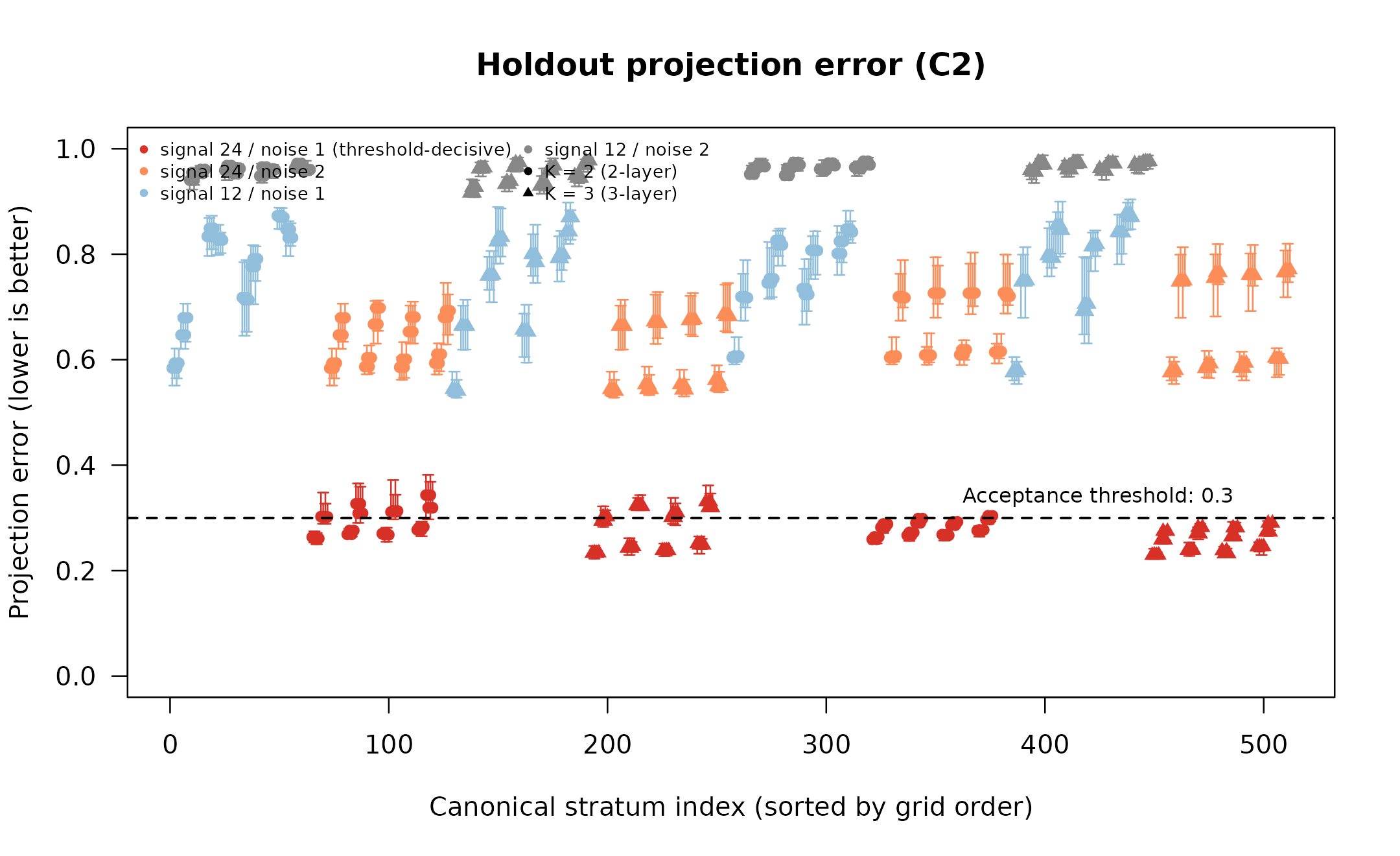
Figure 2. C2 holdout projection error across all exact-ID strata. Each point is the median projection error (lower is better) for one canonical stratum over 20 holdout seeds, with 95% bootstrap confidence intervals. Colour and symbol encoding as in Figure 1. The dashed horizontal line is the frozen acceptance threshold (0.30). The low band of points (projection errors 0.22-0.35) corresponds to high-signal strata where the method partially captures the shared direction; the upper band (0.6-1.0) indicates near-complete failure. Even in the best-case high-signal, low-noise strata, a substantial fraction of replicates exceeds the threshold.
Provenance and next step
The checked artifact coverage comprises all 40,960 synthetic tasks
and 81,920 candidate-result rows. Full artifacts are published only once
every task checkpoint is complete, so this result has no failed tasks.
It also records the seed manifest, protocol and generator digests, the
calibration decision, and the holdout report. Its source commit is
6f1f0614b2c4f0d539baa69a20df1ef43705ade6.
The negative confirmation result is retained as evidence. Any future attempt to improve a candidate requires a new ADR and a newly frozen protocol; it must not reuse or tune against this holdout.